I finished this masterpiece today. And I don't take that word lightly. (It's like the word 'amazing'....totally overused, especially in reality tv) I'm not a big non-fiction gal, but this won me over. Reading The Boys in the Boat filled me with a sense of patriotism and admiration and I am confident it would do the same for you. Couple that with the descriptive portrayals of the Washington countryside, the stark coldness of a rising Nazi Germany, and the fighting spirit of Olympians and you have a winner. If you liked Unbroken, this book is for you. If you are into sports, this book is for you. Heck, if you can read this book is for you. Happy Reading!
Four sisters and a whole lot of books. We'd look into rehab, but that's just more reading.
Books are cheaper than heroin, but they DO add up....
Amy, Carrie, Chanin and Sarah buy (and read and review) their own stuff. They've been known to shop around from dealer to dealer looking for the best price. If you're interested in slipping them something to try out, just contact us.
Showing posts with label non-fiction. Show all posts
Sunday, January 17, 2016
Friday, January 25, 2013
Saying Good-bye to Stan Musial
(This post was originally run on February 9, 2012. In light of yesterday's public visitation and tomorrow's private funeral. We're running it again.)
Wanna hear something awesome?
Pitchers and catchers report on February 18.*
I know. It makes you giggle, doesn't it?** I don't care if that groundhog tangoed with his shadow, Spring Training is around the corner, and THAT means spring is on the way.***
*For the St. Louis Cardinals, that is. Not every team starts on the same day. Check out the schedules here.
**Actually, based on the number of you that commented on the last post that sports = guy stuff, you may not be giggling. You may not even care. It's okay. I still love you. I may not understand you, but we can still be friends.
***Yes, yes, winter hasn't really been that bad. I don't care. I'm ready for spring and Spring Training.
| My precious . . . I mean, the Commissioner's Trophy |
(deep breath)
Where was I? Right. Spring Training is right around the corner, and while my baseball team won't look exactly like it did this time last year****, that's okay because a new season is a fresh start. During Spring Training, the post-season is still every team's dream. Every pitcher still has a chance for a shut-out; every catcher has a chance to throw out that sneaky baserunner. Every batter has a chance to hit like The Man, Stan Musial (career .331 batting average, 475 HR, 1951 RBI.)
****No. We're not going to talk about that here. We're going to talk about the real Man.
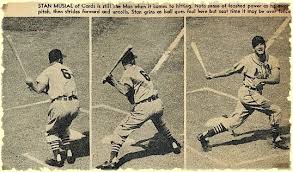
| Stan is known for his stance. |
Stan Musial is arguably the best player to ever wear a Cardinal uniform. He is arguably one of the best players to wear any baseball uniform, frequently spoken of as part of the Big Three (Musial, DiMaggio, and Williams). In Stan Musial: An American Life, George Vecsey argues those cases well. For Stan Musial, the usual Spring Training dreams of position players--hitting well, winning pennants, and being chosen as an All-Star--were a reality for most of 22 seasons. In addition to being amazing on the diamond, Stan is generally referred to gentleman off the diamond and a savvy businessman. Would that all professional athletes had his commitment to his wife, his soft touch with fans, and his foresight to earn money in non-athletic pursuits. We'd have a lot more role models in professional sports if they did.
In fact, Stan Musial: An American Life almost seems too good to be true. The stories told, though, are consistent with what was said about Stan when he was an active player and when he was an active businessman. The only real complaints to be found about Stan seem to be that he wasn't omnipotent. If his teammates were looking for a political leader who would use his weight to address the social inequalities of his time, they were looking in the wrong place. Stan wasn't the kind of teammate to chase confrontation. If his hometown was looking for someone to save a small town in the Rust Belt, they were looking in the wrong place. Stan was known to be generous on an individual basis, but he never formed a foundation that makes major donations for hospital wings and children's libraries.
So it seems that Stan wasn't perfect, but as man he was very, very good, and as a player he was great. I'll take that, and I'll take George Vecsey's collection of Stanley anecdotes to carry me over until the baseball season really begins. I liked this glimpse into the history of baseball (Musial's career spanned racial integration and union formation) and the history Stan (his upbringing, his playing days, and his relationships).
For a St. Louis Cardinals fan, this is a must read. For a true fan of baseball, this is a must read. For all of us, it's a great lesson of a life of meaning and value.
Labels:
Carrie,
non-fiction,
rerun
Thursday, May 31, 2012
Into the Wild by Jon Krakauer
| I don't always wear a bonnet. But when I do, I'm usually drinking. |
Into the Wild became a book after Mr. Krakauer investigated the circumstances of Christopher Johnson McCandless's death for Outside magazine. (I assume by now it's obvious that I'm not a subscriber to said magazine, and therefore wasn't aware of this incident until I saw this book...at an indoor book store....where there's no nature except in pictures. As it should be.) The book is the culmination of Mr. Krakauer's investigation and research into the odd matter. It's not odd that someone would die in the remote wilderness of Alaska, but it is odd that before his sojourn into Seward's Folly, McCandless basically disavowed established society after an upbringing that embraced it. The book traces McCandless's nomadic steps after his graduation from Emory University in 1990 to his death alone in the Alaskan wilderness north of Mt. McKinley in 1992.
Krakauer interviewed those known to have come in contact with McCandless, though he went by the name Alexander Supertramp at the time. There are many things that no one will ever be able to piece together. What Krakauer was able to discern comes from Alex's journals and interviews. Apparently Alex came to believe writers such as Tolstoy, Thoreau, and Jack London understood how one should live: without an attachment to materialistic things and an ability to live off the land. Alex started off on his journey in his own vehicle, but after it was flooded around Lake Mead he abandoned it and continued by means of hitch hiking and train jumping. As he left his car, he also burned all of his identification and cash so he left with a backpack of meager supplies and his journal. From there he traveled through South Dakota, Nevada, even as far south as Mexico before he made his way back to South Dakota. There he worked for a friend he had made during his first trip through the state, as a way to earn money for supplies for his ultimate destination: Alaska.
| Mt. McKinley |
Labels:
non-fiction,
Sarah
Monday, March 26, 2012
Nudge by Richard Thaler and Cass Sunstein
| Don't use too much energy. Be happy! |
is enough to convince you to keep your energy use lower than your neighbor's. For real.
Want to figure out how to do the responsible thing with your next pay raise and put the money into a retirement plan or savings account? Ask your employee to start a Save More Tomorrow program where the money is automatically deposited. They work like a charm. Also, for real.
Both of these revelations are found in Nudge: Improving Decisions about Health, Wealth and Happiness by Richard Thaler and Cass Sunstein. Thaler and Sunstein recommend that choice architects (anyone responsible for making choices available, whether it's human resources staff, the government, or the people who set up a cafeteria line) structure options according to paternal libertarianism. The idea IS to provide choices instead of limiting choices or making decisions for other people, but to structure or arrange the choices so that the "good" choice, the best choice for the choosers, is easily accessible and painless.
Here's an example I've already referenced: Save More Tomorrow programs. Most companies recognize that it is in their employees best interests to save money for retirement. Yet, most of us are miserable at saving because we already spend all the money we make. How could we squeeze out enough from our monthly budgets to allow for retirement savings? What would we willingly give up? Saving today is hard, but saving more tomorrow is much easier. If companies want to encourage employees to save money in 401ks or IRAs, they simply need to set up a program that allows employees to designate that part (or all) of future raises will automatically go into a retirement account. That way no one needs to make any adjustments to their current budgets. The temptation of spending the money is also removed because the savings are deposited separately at the same time as the rest of the the paycheck. Most employees will keep doing this for as long as they work for that employer. By giving us choices, but making sure to include an easy and mostly painless option to do the right thing, employers can practice paternal libertarianism.
Another almost frightening example is the influence of the smiley face on energy consumption. Utility companies know that transparent displays of consumption can convince high users of energy to lower their consumption, so if your power bill shows you that you use noticeably more power than your neighbors you'll try and reign in your energy use. Unfortunately, transparent displays of consumption have the opposite effect on low users of energy. If your power bill shows that you use less energy than your neighbors do, you'll ramp up your usage. Apparently, that information works as a cue that you could be using more UNLESS the power company provides another cue, the smiley face, to encourage you to keep your consumption low.
Crazy, isn't it? That the littlest, most innocuous cue could have that much influence? Nudge is full of examples of how little changes in the way choices are presented alters which option is chosen. It's a fascinating read, and despite the academic backgrounds of the authors (both are University of Chicago faculty) it's an easy read, too. I recommend it. It can change the way you make your own decisions and they way you set up options for others.
Labels:
Carrie,
non-fiction
Friday, February 17, 2012
Ellis Island Interviews by Peter Morton Coan
This is a collection of interviews of immigrants and federal employees, all connected through Ellis Island. For 62 years (1892-1954), the Golden Door was the headquarters for Immigration and Naturalization Services for the New York area. During that time the INS processed more than 12 million immigrants, setting the stage for a diverse United State of America. Just imagine the how crazy every day at work must have been for the employees, as they processed hundreds of people speaking different languages, many of whom would have been on solid ground for the first time in weeks. The facility is now part of the National Park Service and its vast number of buildings have been partially restored. It's a place I hope to visit sometime. To walk in the footsteps of the millions who left everything behind to seek a different, hopefully better and prosperous, life here in America. Not to get too grandiose, but these are people that made a leap of faith that spanned continents and oceans and Ellis Island would be their first look at their landing point; pretty cool, in my dorky opinion.
This book provides a brief history of how the island became the portal to America and then presents the interviews in chapters divided by nationality, along with a chapter for employees. There are a number of photographs and drawings as well as some transcripts of the "investigation" of some immigrants (including Bella Lugosi who did not mention anything about sucking blood or changing into a bat at any point during his interview). The book is well organized and laid out so it's easy to pick and choose chapters of specific interviews if you don't want to read them all, but once you start it's hard to stop. One of my favorite interviews was that of Dr. James Baker who served as the psychiatrist on the island for two years. He describes some of the treatments they used on "excited" immigrants who had been sent to him for further consideration. Hydrotherapy, electro-shock, lobotomies....they apparently did it all there. Also Leslie Townes, who was five when his family emigrated, discusses how he later saw Ellis Island and thought "thanks for the memory." Turned out to be a pretty good thought for Leslie Townes, better known as Bob Hope. There's an interview of three siblings (with some very awesome sibling interjections) from Poland who mostly remember being detained for six weeks due to ringworm and that they learned to speak English in less than two months after they arrived. All walks of life from all over the globe were interviewed for this book, making it full of gossip and good stories. If you're into that sort of thing.
PS for Natalie: Baron von Trapp came to America through Ellis Island in 1938. So now you know they made it through the mountains. :)
Labels:
non-fiction,
Sarah
Thursday, February 9, 2012
Stan Musial: An American Life by George Vecsey
Wanna hear something awesome?
Pitchers and catchers report on February 18.*
I know. It makes you giggle, doesn't it?** I don't care if that groundhog tangoed with his shadow, Spring Training is around the corner, and THAT means spring is on the way.***
*For the St. Louis Cardinals, that is. Not every team starts on the same day. Check out the schedules here.
**Actually, based on the number of you that commented on the last post that sports = guy stuff, you may not be giggling. You may not even care. It's okay. I still love you. I may not understand you, but we can still be friends.
***Yes, yes, winter hasn't really been that bad. I don't care. I'm ready for spring and Spring Training.
Look at the shiny, pretty, precious trophy. It's actually coming to a cell phone store near me!! For realz!!! I, I, um. . . actually, maybe my exclamation points and I should have a moment to ourselves.
(deep breath)
Where was I? Right. Spring Training is right around the corner, and while my baseball team won't look exactly like it did this time last year****, that's okay because a new season is a fresh start. During Spring Training, the post-season is still every team's dream. Every pitcher still has a chance for a shut-out; every catcher has a chance to throw out that sneaky baserunner. Every batter has a chance to hit like The Man, Stan Musial (career .331 batting average, 475 HR, 1951 RBI.)
****No. We're not going to talk about that here. We're going to talk about the real Man.
Stan Musial is arguably the best player to ever wear a Cardinal uniform. He is arguably one of the best players to wear any baseball uniform, frequently spoken of as part of the Big Three (Musial, DiMaggio, and Williams). In Stan Musial: An American Life, George Vecsey argues those cases well. For Stan Musial, the usual Spring Training dreams of position players--hitting well, winning pennants, and being chosen as an All-Star--were a reality for most of 22 seasons. In addition to being amazing on the diamond, Stan is generally referred to gentleman off the diamond and a savvy businessman. Would that all professional athletes had his commitment to his wife, his soft touch with fans, and his foresight to earn money in non-athletic pursuits. We'd have a lot more role models in professional sports if they did.
In fact, Stan Musial: An American Life almost seems too good to be true. The stories told, though, are consistent with what was said about Stan when he was an active player and when he was an active businessman. The only real complaints to be found about Stan seem to be that he wasn't omnipotent. If his teammates were looking for a political leader who would use his weight to address the social inequalities of his time, they were looking in the wrong place. Stan wasn't the kind of teammate to chase confrontation. If his hometown was looking for someone to save a small town in the Rust Belt, they were looking in the wrong place. Stan was known to be generous on an individual basis, but he never formed a foundation that makes major donations for hospital wings and children's libraries.
So it seems that Stan wasn't perfect, but as man he was very, very good, and as a player he was great. I'll take that, and I'll take George Vecsey's collection of Stanley anecdotes to carry me over until the baseball season really begins. I liked this glimpse into the history of baseball (Musial's career spanned racial integration and union formation) and the history Stan (his upbringing, his playing days, and his relationships).
For a St. Louis Cardinals fan, this is a must read. For a true fan of baseball, this is a must read. For all of us, it's a great lesson of a life of meaning and value.
Pitchers and catchers report on February 18.*
I know. It makes you giggle, doesn't it?** I don't care if that groundhog tangoed with his shadow, Spring Training is around the corner, and THAT means spring is on the way.***
*For the St. Louis Cardinals, that is. Not every team starts on the same day. Check out the schedules here.
**Actually, based on the number of you that commented on the last post that sports = guy stuff, you may not be giggling. You may not even care. It's okay. I still love you. I may not understand you, but we can still be friends.
***Yes, yes, winter hasn't really been that bad. I don't care. I'm ready for spring and Spring Training.
| My precious . . . I mean, the Commissioner's Trophy |
(deep breath)
Where was I? Right. Spring Training is right around the corner, and while my baseball team won't look exactly like it did this time last year****, that's okay because a new season is a fresh start. During Spring Training, the post-season is still every team's dream. Every pitcher still has a chance for a shut-out; every catcher has a chance to throw out that sneaky baserunner. Every batter has a chance to hit like The Man, Stan Musial (career .331 batting average, 475 HR, 1951 RBI.)
****No. We're not going to talk about that here. We're going to talk about the real Man.
| Stan is known for his stance. |
Stan Musial is arguably the best player to ever wear a Cardinal uniform. He is arguably one of the best players to wear any baseball uniform, frequently spoken of as part of the Big Three (Musial, DiMaggio, and Williams). In Stan Musial: An American Life, George Vecsey argues those cases well. For Stan Musial, the usual Spring Training dreams of position players--hitting well, winning pennants, and being chosen as an All-Star--were a reality for most of 22 seasons. In addition to being amazing on the diamond, Stan is generally referred to gentleman off the diamond and a savvy businessman. Would that all professional athletes had his commitment to his wife, his soft touch with fans, and his foresight to earn money in non-athletic pursuits. We'd have a lot more role models in professional sports if they did.
In fact, Stan Musial: An American Life almost seems too good to be true. The stories told, though, are consistent with what was said about Stan when he was an active player and when he was an active businessman. The only real complaints to be found about Stan seem to be that he wasn't omnipotent. If his teammates were looking for a political leader who would use his weight to address the social inequalities of his time, they were looking in the wrong place. Stan wasn't the kind of teammate to chase confrontation. If his hometown was looking for someone to save a small town in the Rust Belt, they were looking in the wrong place. Stan was known to be generous on an individual basis, but he never formed a foundation that makes major donations for hospital wings and children's libraries.
So it seems that Stan wasn't perfect, but as man he was very, very good, and as a player he was great. I'll take that, and I'll take George Vecsey's collection of Stanley anecdotes to carry me over until the baseball season really begins. I liked this glimpse into the history of baseball (Musial's career spanned racial integration and union formation) and the history Stan (his upbringing, his playing days, and his relationships).
For a St. Louis Cardinals fan, this is a must read. For a true fan of baseball, this is a must read. For all of us, it's a great lesson of a life of meaning and value.
Labels:
Carrie,
non-fiction
Monday, February 6, 2012
FREE BOOK! and Those Guys Have All the Fun by James Andrew Miller and Tom Shales
So it seems we've been blogging on our itty bitty book blog for about a year now. My how quickly the pages turn! It makes us feel like we should celebrate so this month each one of us is giving a book away. And I'm going to start! But before we get to the free book, how 'bout I review one? Mmkay? Okay.
I'm not going to lie or try to dress this up. I read this for the gossip. It's huge (745 pages) much like the network it tracks from an idea by an out-of-work father and son to the sprawling multi-national mega-corporation it is now. Even if you're not into sports, I bet you'd know what you can find on ESPN (Which they used to refer to as E.S.P. Network. Which I find amusing.). The book is easy to read despite its ability to kill an entire colony of ants in one fell swoop. It reads like a documentary; the name of the speaker is given and then large amounts of direct quotes. It's clear that the authors shaped and edited the content (as in didn't put a Mark Shapiro quote about the show PTI in the section discussing the initial funding for the network), but the entire book is 90% direct quotes from what must have been thousands of hours of interviews. A lot of time and work went into the making of this book, but fortunately it won't take you as long to read it.
What brought me to this book is my love of Dan Patrick. He is unaware of our relationship, but we're boyfriend/girlfriend. I listen or watch his show exclusively now, so it's pretty serious. His split from ESPN (where he was part of what I consider to be the greatestSportsCenter duo ever) was acrimonious to say the least, so when the book came out I wanted to read up on all the gossip I could. There is plenty of information here, but the breadth of the subject is so wide that it doesn't focus nearly enough on my boyfriend. Of course, I could be biased. Overall, the book casts a positive tone; choosing to regard ESPN as a competitive entity in the sports information world. Which is certainly is. There are people who feel that ESPN is too powerful and has too much sway in certain sports and media circles, but the book doesn't really get into that in great detail. Regardless of that, if you're looking for information about this gigantic, 24-hour, sports-fueled machine called ESPN, then look no further.
Here are some things I learned:
1. Dick Vitale, Bob Ley, and Chris Berman all joined ESPN within the first year (1979 ish) and all are still with the company.
2. The infamous promos for SportsCenter, all ending with the tag-line "This is SportsCenter", developed from one of many skirmishes between Keith Olbermann and the management.
3. We have ESPN to thank for the NFL Draft being as annoying as it is. It was their idea to televise it starting in 1980.
4. Denise Austin used to have air-time on ESPN. They made her acquire her own sponsor, she produced her own exercise show, and now she's an aerobics legend.
5. If it weren't for the NCAA wanting a place for its basketball tournament and Getty family money being at the discretion of a guy who liked sports and off-beat ideas, then we'd still be getting sports information from our local news.
6. For my brother: In 1979, RCA was making "concept sales" of satellite transmissions. Everyone knew about cable and its physical locations, but very few people understood the implications of satellite broadcasting. Basically that something that got picked up on one spot could be sent world wide. They convinced the Rasmussen's of the fledgling ESP Network to buy one of their two transponders for $34, 167 a month.
7. While we all know how incredibly stupid and obnoxious The Decision was (in terms of both television programming and humanity in general), LeBron James and his decision about his talents were watched in about 10 million homes.
8. It's a long, complicated, wild book, but worth the read.
FREE BOOK!!!!!!!
Speaking of complicated and wild.....I'm giving away Wild Rideby Jennifer Crusie and Bob Mayer to one lucky commenter. I reviewed one of their other books, Agnes and the Hitman, earlier. You can find the review here. I picked this book to give away because: it's a lot of fun to read; it's got romance, humor, demons, ice cream AND amusement parks; it's been something of a wild ride for us here lately. The only thing you need to do to enter is leave a comment telling us your favorite book and your email address. Leave a comment by Thursday, Feb. 9th, at midnight. Yay! Free book!
Here's some SportsCenter for you too!
And for Giants fans:
Labels:
giveaway,
non-fiction,
Sarah
Tuesday, January 31, 2012
Liespotting: Proven Techniques to Detect Deception by Pamela Meyer
I have a fairly firm rule about reading the book before watching the movie. Seriously, the book is usually SO much better I can't imagine wanting to start with the inferior product. (Ask me some other time about the ex who told me I'd understand Sophie's Choice better if I watched the movie. I suspect you know the ending of the story.) And, in reading Liespotting: Proven Techniques to Detect Deception by Pamela Meyer I didn't break the rule per se. Because, well, no one's putting together "Liespotting: The Movie!" But . . . let's just say that Liespotting was ruined for me by this guy
and this guy.
So in a way, I did see the movie first because I learned the material delivered in Liespotting in two very entertaining and accessible formats.
But let me back up. Liespotting is a book about deceptive behavior and how to detect it. It covers the basics of microexpressions--the little expressions we all make (and occasionally try to cover up) that depict our true, immediate responses to a situation. It also covers the basics of other nonverbal behaviors that can be used to detect lies. As an introduction to the detection of deceptive behavior it's very thorough, and on Amazon this is a really well reviewed book. The topic of this book? The topic of this book I find fascinating.
I still didn't like it. First, it's very basic. As one of the Amazon reviews says if you've not ready anything on the topic before, this is a good place to start. On the other hand, if you've read Blink or watched a handful of episodes of "Lie to Me". (That part's my opinion, not the opinon of the reviewer.) Second, lie detection is a very visual endeavor, and this book doesn't really do the visual aspect justice. So if you're interested in the topic, I suggest you get yourself a does of Tim Roth or Malcolm Gladwell and jump into the the entertaining and accessible versions of this information.
| Tim Roth was so much fun to watch in "Lie to Me". |
and this guy.
| Malcolm Gladwell covered microexpressions in Blink. |
But let me back up. Liespotting is a book about deceptive behavior and how to detect it. It covers the basics of microexpressions--the little expressions we all make (and occasionally try to cover up) that depict our true, immediate responses to a situation. It also covers the basics of other nonverbal behaviors that can be used to detect lies. As an introduction to the detection of deceptive behavior it's very thorough, and on Amazon this is a really well reviewed book. The topic of this book? The topic of this book I find fascinating.
I still didn't like it. First, it's very basic. As one of the Amazon reviews says if you've not ready anything on the topic before, this is a good place to start. On the other hand, if you've read Blink or watched a handful of episodes of "Lie to Me". (That part's my opinion, not the opinon of the reviewer.) Second, lie detection is a very visual endeavor, and this book doesn't really do the visual aspect justice. So if you're interested in the topic, I suggest you get yourself a does of Tim Roth or Malcolm Gladwell and jump into the the entertaining and accessible versions of this information.
Labels:
Carrie,
non-fiction
Friday, January 13, 2012
Sleepwalk With Me by Mike Birbiglia
Sleepwalk With Me is Mr. Birbiglia's account of his adventures with sleepwalking (hey! what a surprise!), and other stories from his youth and his career in stand-up comedy. Bonus: I can count this as a non-fiction read. It is funny. It is sometimes sweet. It is short. It's the perfect book to have on an airplane; engaging enough that you want to continue reading, but not too complicated that you can't put it down to get your in-flight complimentary beverage and your pretzels.
The thing I liked most about this book, and honestly the comedy I have subsequently watched, is that Mr. Birbiglia is funny in a self-aware, self-deprecating manner without being mean to everyone else he has ever come in contact with. That's not easy to do. Many comedians are hilarious but at the expense of others. This is not the case with Mr. Birbiglia. Not that he doesn't point out some of the absurdities of, well, life in general, but for the most part he doesn't make himself out to be above all that absurdity. It was nice to laugh but not feel guilty about it.
Two of my favorites chapters/stories:
Delusional - in which he discusses his childhood aspirations to be a rapper, a comedian, a poet, a professional basketball player, a country singer, a break-dancer, or the owner of a pizza restaurant (where third graders could hang out). That's a lot of aspiring.
Please Stop the Ride - the telling of his attempts at romance and eventually hanging out with his first real girlfriend......and her real boyfriend. Nothing says "first love" like meeting your girlfriend's other boyfriend's parents.
Sleepwalk with Me was also an off-Broadway show (presented by Nathan Lane!) and a motion picture (accepted into Sundance!). The title is not metaphoric; he does have a serious issue with sleepwalking that required medical attention. Those stories are also very funny, but sometimes in the "This is only funny because you're writing about it now and I know you're fine, so we can chuckle about this now." kind of way. During my YouTube search for Mr. Birbiglia's stand-up act, I came upon a series of videos featuring him and some random people who had purchased his book. He would video chat with these, I'm assuming, strangers to thank them for buying his book. Now that's an awesome idea. And we be thrilled to let him comment/video chat/personalize a song for our little book blog if he feels so inclined after Google alerts makes him aware of us. I thought about putting one of those thank-you videos here, but then I found this one and it made me snort. Happy Friday!
Labels:
humor,
non-fiction,
Sarah
Thursday, December 29, 2011
Destiny of the Republic by Candice Millard
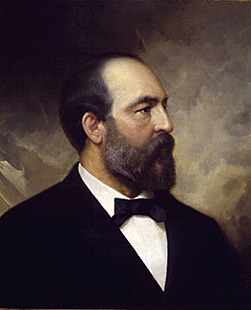
(I really should have known more about this guy.)
need to be quick about this because I stepped out of a Super Secret Spy meeting to blog. I shouldn't even be telling you because, duh, it's super secret. But . . . we're all friends here, so I think I can mention my clandestine life* in passing. I can't give you much detail, because, again, duh, then I'd hafta kill you.
*I'm a Super Aunt, see, and that sometimes involved spending time fighting the "bad guys" with your nieces and nephews.
The main subjects of Destiny of the Republic also have their clandestine elements. There is the unseen bacteria that ultimately killed a President, there are the behind-the-doors machinations of a political party, there are the internal delusions of a mad man, and there is mostly forgotten life of the 20th President of the United States.
I can honestly say that what I knew about President Garfield before I read this book wasn't enough to drown in. I had a vague recollection that he was shot because his assassin wanted a job. In my foggy and vague memories, the gun shot killed Garfield and the assassin was a supporter of Vice President Chester Arthur. It was true that the man who shot President Garfield, Charles Guiteau, wanted an appointment, but it was truly his own madness that led him to believe that God wanted Garfield removed from office. Guiteau believed that President Garfield was a threat to the Republic and to the Republican Party. And while Garfield died from complications from his wounds, it was truly preventable and curable infection that killed him instead of the initial injury.
So I was nominally right, but mostly I was really, really wrong.
Destiny of the Republic is mostly outside my reading sweet spot. There are no vampires, there's not much romance, and, for goodness sake, it's non-fiction. However, it was really, really interesting.
I learned a lot. I was mesmerized by the politics of the day; they weren't that different from those of today but much of the obnoxious behavior was in-party fighting instead between party. The current state of the medical field was horrifying and gripping. The drive of Alexander Graham Bell to invent a machine that would help locate the bullet still lodged in the President's body was riveting. The audacity and insanity of Charles Guiteau was astounding.
All in all, I highly recommend Destiny of the Republic. It's tone and delivery reminded me of Devil in the White City by Erik Larson (another non-fiction book I highly recommend).
In summary, you should read this book, and I should get back to my meeting. The world is depending on me, or, at least, a niece and a nephew.
Labels:
Carrie,
non-fiction
Tuesday, December 20, 2011
What the Dog Saw: And Other Adventures by Malcolm Gladwell
Personally, I'm a fan of Malcolm Gladwell's. I love The Tipping Point so much that I make my Consumer Behavior students read it. I thought Outliers was an amazing, and Blink is interesting (if frustrating because I don't think he ever answers his own core question.) Not everyone agrees with me. Every once in a while I'll hear colleagues scoff at the mention of Gladwell's name; they'll claim that others write on similar topics with more depth. Every once in a while I'll see acquaintances roll their eyes when I mention something from The Tipping Point; they tell me that Gladwell only writes about the obvious.
Here's what I have to say about that:
a) every one of us is entitled to our own opinions, and
b) really? You call that a critique?
(Err, so maybe I need to work on my application of the "live and let live" philosophy. Peace. Goodwill to men and all that.)
Gladwell writes, really well, for a non-academic audience. His writing is as in-depth as is appropriate for his readers. Also, OF COURSE it all seems obvious after you've read his work. That means he's done an amazing job finding and retelling stories that support a general premise. Perhaps he's writing about things you've already thought about, but he's taken those questions we all have and done something with them. He's researched and retold the answers to questions that resonate with so many of us. Gladwell writes about the things that make us go "Hmm."
I think for the everyday reader and the typical undergraduate student (two mutually exclusive categories, those) Gladwell makes for an excellent read. It's with that opinion that I recommend What the Dog Saw: And Other Adventures. This book is a collection of magazine articles Gladwell wrote for The New Yorker. For a consumer behavior junkie like me, this book simply rocks. Even if you've never been fixated on brands and logos and service recovery, this is a a good read*. There's a crazily interesting article about ketchup. (No joke.) Have you ever considered that there are yellow mustards, brown mustards, spicy mustards, and plain mustards, but, for most of America, there's really just Heinz ketchup? There's a great piece about Ron Popeil and the history of Billy Mays-like salesmanship. How many items have you purchased based on the power of a demonstration? There's also a really cool article about Cesar Millan, the dog whisperer. What does the dog see, after all?
I'm also specifically recommending it for holiday reading because a collection of magazine articles has definitive stops and starts. For those of you still shopping, wrapping, shipping, cleaning, cooking, and decorating for the December holidays, this book is nice to have right now because you can pick it up and put it down. You can use it as a short break between tasks without worrying about getting sucked in to a 300-page plot that you just can't seem to ignore. After 20 pages about ketchup, you can put the book down and process what you've read as you go back to your cookie dough.
*I liked this book enough that I'm willing to recommend it EVEN THOUGH the articles on behavioral profiling have pretty much ruined Criminal Minds for me.
Labels:
Carrie,
non-fiction
Friday, December 2, 2011
There Are No Children Here by Alex Kotlowitz
Have I mentioned that I love it when people recommend books for me to read? My neighbor loaned me this one claiming it was one of her "go to" books. She keeps it solely for the purpose of loaning it out to friends, meaning it has probably moved at least five times thanks to the Army. If it's good enough to withstand a PCS (permanent change of station) purge (something we military spouses do regularly before we move), I had to give it a try. I'm glad I did.
Set in Chicago and centered around the lives of two brothers in the late 1980's/early 1990's, "There are No Children Here" is a non-fiction piece (Don't act so shocked. I read non-fiction...sometimes), and reports on the happenings in their lives for approximately two years. That's it. That's all it is. But it is so much more.
The brothers, Lafayette and Pharoah Rivers, live in the Henry Horner homes. Erected in the 1950's by the Chicago Housing Authority, the Henry Horner homes brought hope and encouragement to thousands of lower income families on Chicago's south side. By the time we meet the boys in 1985 however, hope and encouragement have turned to poverty and despair. Unemployment is rampant among the occupants and so are drug use and gang violence. The boys' mother, LaJoe, told the author, "There are no children here. They've seen too much to be children."
The story isn't pretty. The conditions in their two- bedroom apartment on the first floor of a 14-story high rise are despicable. The plumbing doesn't work. The heating and air-conditioning are unreliable. Garbage overflows into the hallways. The children spend hours on the floor in the kitchen to avoid the intermittent gunfire that takes place outside their living room window. Oftentimes, their apartment is overflowing with relatives that need food or a place to sleep. The boys' father regularly passes out drunk on the couch.
It may sound odd that I found an instant connection to this book. Theirs is a story of survival. In the mid 1980's I was the same age as Lafayette and the only thing I had survived was a 24-hour road trip from Oklahoma to Montana in the back of a Chevy Celebrity. (That trip was made all the more bearable thanks to my yellow Sony Walkman and Ghostbusters soundrack). I certainly never had to worry about gunfire outside my house. We had plumbing that worked and the trash was picked up every Monday. But I know that I saw these boys. I saw them every time my dad took me to a Chicago Bulls or White Sox game. I saw them offering to "watch" cars while we went inside to the game, hoping to make a few bucks. I saw them goofing around with their friends on the sidewalk. I saw them then and used to say to myself, "I can't imagine living here."
By spending the better part of two years with the boys and their family, the author exposes us to the disturbing reality that is growing up on Chicago's west side. I was amazed at how open the family was and how every day was just "business as usual." The boys may have attended a funeral of a classmate one day and then participated in a spelling bee the next. Violence, drugs, gangs, school, work, hunger, exhaustion and love surrounded them, just not all at the same time. I marveled at their resiliency. The ending is neither tragic or shocking. Actually, it's not even really an ending. Their lives go on (I know because I googled them, hoping they hadn't succumbed to gangs or drugs). Thanks to the generosity of the author and some other special people, they both went to college and as far as I can find, still live in Chicago. That's it. That's all there is for now. But for them, it's so much more.
Labels:
Amy,
Chicago,
non-fiction
Thursday, August 25, 2011
Take Five: Four Favorite Essays Plus One Never-Been-Seen Essay by Augusten Burroughs
I was bamboozled into reading my first Augusten Burroughs book.
His writing had been compared to David Sedaris'. I was intrigued. When I read Sedaris' Me Talk Pretty One Day, I laughed until I cried. My favorite part is when a group of non-native French speakers are trying to explain, in French, the basic concepts of Easter to a Moroccan Muslim. There's just something HI-larious about people with extremely limited vocabularies trying to define the complex concepts of faith. Honestly, I had to stop reading it because I was laughing and crying so hard.
So, great! Burroughs is like Sedaris, and Sedaris doesn't write fast enough to satisfy me (but, really, who does?), so I'll buy Running with Scissors and enjoy some similar observational humor. But Running with Scissors was like Me Talk Pretty One Day the way the Mel Gibson's "The Passion of the Christ" is like a Cadbury egg commercial.
While they're not totally unrelated, one is significantly more startling than the other.
How anyone read about Burroughs as a neglected and abused child in Running With Scissors and labeled it "observational humor" OR thought that those episodes would make a funny movie is beyond me.
It's safe to say that the book did not meet my expectations. It did, however, introduce me to Burroughs' writing and make me like him for his own merits. Since that time I've read everything he's published, and since that time, he's occasionally written about easier topics than his own childhood. In those instances, it's apparent why he would be compared to Sedaris. When given the right topics, those are two very funny guys. In fact, the essays in Take Five are some that could handily be compared to Me Talk Pretty One Day.
The opening essay, "Mint Threshold," is an insightful and humorous episode of Burroughs' life in the advertising industry. "Debbie's Requirements" is a laugh-out-loud take on hiring a cleaning lady. (Let's just say the characters from The Help would not be threatened by Debbie's work ethic.) The other three essays are in a similar vein. All in all, Take Five is a fast, fun read that I would recommend to anyone who hasn't already consumed Magical Thinking or Possible Side Effects. (If you have read these, the new essay isn't long enough to justify buying the four reprints unless you just REALLY want to.)
(And, for the love of Cadbury eggs, do not pick up one of his serious books--Dry, Running with Scissors, A Wolf at the Table--expecting to laugh until you cry. They're all great books, but they'll just make you cry.)
*****
As always, I've managed to turn one book review into about seven. Here are the links to all the books I've referenced in this review. Me Talk Pretty One Day, Running With Scissors, Dry, Magical Thinking, Possible Side Effects, A Wolf at the Table.
Labels:
Carrie,
non-fiction
Monday, June 13, 2011
Into Thin Air: A Personal Account of the Mt. Everest Disaster by Jon Krakauer
I know....I can't believe I read this book either! It's not at all something I normally go for. It's not even fiction, for crying out loud! I picked it up on the fly at Barnes and Noble one day when I was there with both kids, a latte in one hand and a little boy dragging me back to the train table in the other hand. He won (he's a freakishly strong kid) and thankfully, so did I. The book was good.
Into Thin Air is the story of the May 1996 disaster on Mt. Everest that killed eight climbers. The author, Jon Krakauer, was hired to climb to base camp of Mt. Everest and report back to his magazine, Outside. His story was to simply cover the commercialization of Everest, Nepal and the surrounding Sherpa community. Instead, Krakauer actually made it all the way to the summit and then was engulfed in the deadly storm that killed his guide and three others during their decent.
The first thing that struck me about this book is how many people commented on it when I was out in public. I was stopped in the lobby of the doctor's office, while I was getting my hair colored (Surprise! I'm not a natural blonde) and even at my son's tae kwon do lesson. People wanted to talk about this book! They wanted to tell me about their recent climb or how they sympathized with the sherpa community in Nepal. I expect comments when I am reading a new release or maybe something about a polarizing political figure, but I wasn't expecting full on conversations about this book. Something about this book makes people feel a connection to the adventure and ultimately, the mountain.
I don't read non-fiction that often (okay, never) so maybe I am just naive, but the amount of detail and chronological fact in this book astounded me. Yes, the author was being paid to write about his experience, and yes, this had been a childhood dream, but holy smokes! When you couple that with the fact that most of this was experienced at lower-than-normal oxygen levels, you really get an appreciation for all of the detail in this book. The story is told well, follows a nice time line (which if you will remember from previous reviews, I am a big fan of) and provides not only factual but cultural insight. The only thing that would have made it better was if the storm hadn't come and wiped out half of the climbing team. That part was a huge bummer.
After reading Into Thin Air, I want to try another non-fiction piece. As a matter of fact, I would love some suggestions from our readers. The next time I am being whisked through Barnes and Noble with my latte and my freakishly strong boy, I may not get as lucky.
Into Thin Air is the story of the May 1996 disaster on Mt. Everest that killed eight climbers. The author, Jon Krakauer, was hired to climb to base camp of Mt. Everest and report back to his magazine, Outside. His story was to simply cover the commercialization of Everest, Nepal and the surrounding Sherpa community. Instead, Krakauer actually made it all the way to the summit and then was engulfed in the deadly storm that killed his guide and three others during their decent.
The first thing that struck me about this book is how many people commented on it when I was out in public. I was stopped in the lobby of the doctor's office, while I was getting my hair colored (Surprise! I'm not a natural blonde) and even at my son's tae kwon do lesson. People wanted to talk about this book! They wanted to tell me about their recent climb or how they sympathized with the sherpa community in Nepal. I expect comments when I am reading a new release or maybe something about a polarizing political figure, but I wasn't expecting full on conversations about this book. Something about this book makes people feel a connection to the adventure and ultimately, the mountain.
I don't read non-fiction that often (okay, never) so maybe I am just naive, but the amount of detail and chronological fact in this book astounded me. Yes, the author was being paid to write about his experience, and yes, this had been a childhood dream, but holy smokes! When you couple that with the fact that most of this was experienced at lower-than-normal oxygen levels, you really get an appreciation for all of the detail in this book. The story is told well, follows a nice time line (which if you will remember from previous reviews, I am a big fan of) and provides not only factual but cultural insight. The only thing that would have made it better was if the storm hadn't come and wiped out half of the climbing team. That part was a huge bummer.
After reading Into Thin Air, I want to try another non-fiction piece. As a matter of fact, I would love some suggestions from our readers. The next time I am being whisked through Barnes and Noble with my latte and my freakishly strong boy, I may not get as lucky.
Amazon.com says: Into Thin Air is a riveting first-hand account of a catastrophic expedition up Mount Everest. In March 1996, Outside magazine sent veteran journalist and seasoned climber Jon Krakauer on an expedition led by celebrated Everest guide Rob Hall. Despite the expertise of Hall and the other leaders, by the end of summit day eight people were dead. Krakauer's book is at once the story of the ill-fated adventure and an analysis of the factors leading up to its tragic end. Written within months of the events it chronicles, Into Thin Air clearly evokes the majestic Everest landscape. As the journey up the mountain progresses, Krakauer puts it in context by recalling the triumphs and perils of other Everest trips throughout history. The author's own anguish over what happened on the mountain is palpable as he leads readers to ponder timeless questions.
Labels:
Amy,
non-fiction
Thursday, April 28, 2011
China Road by Rob Gifford
Carrie says:
It should've read like the road trip from hell--two months traveling 2,998 miles from Shaghai to the China-Kazahkstan border. Instead, it read like the end of a really good date the author never wanted to end, the kind where he keeps delaying the inevitable good-bye. Arguably, a two-month trip through China via taxi, truck and bus may be longest and oddest end of a date on record, but it was a lovely good-bye nonetheless.
Rob Gifford, an NPR correspondent, spent six years, from 1999 to 2005, living in China and reporting on Asian news for Morning Edition and All Things Considered. When it was time to move on to the London bureau, he wanted one last memory of China, one last good-bye, one last road trip from hell. In order to accomplish this, he traveled the length of Route 312, China's version of Route 66, interviewing "Old Hundred Names," China's version of John Q. Public.
Of the handful of books on China I've read in the last few months, this one does the best reconciling the paradox of a modern-day ancient civilization. As Gifford writes, "For every fact that is true about China, the opposite is almost always true as well, somewhere in the country." There is prosperity; there is poverty. Times are changing; times are staying the same. Millions are racing toward the future; millions are clinging to the past. In addressing these paradoxes, Gifford writes about the realities and dreams of Old Hundred Names with respect and compassion. He shares his own paradox--his love of the Chinese and his discomfort with and distrust of the behemoth that is China. That love, of course, is the reason what should've been the road trip from hell was really one last, sweet good-bye.
(But don't take my word for it. Here's what Amazon has to say.)
It should've read like the road trip from hell--two months traveling 2,998 miles from Shaghai to the China-Kazahkstan border. Instead, it read like the end of a really good date the author never wanted to end, the kind where he keeps delaying the inevitable good-bye. Arguably, a two-month trip through China via taxi, truck and bus may be longest and oddest end of a date on record, but it was a lovely good-bye nonetheless.
Rob Gifford, an NPR correspondent, spent six years, from 1999 to 2005, living in China and reporting on Asian news for Morning Edition and All Things Considered. When it was time to move on to the London bureau, he wanted one last memory of China, one last good-bye, one last road trip from hell. In order to accomplish this, he traveled the length of Route 312, China's version of Route 66, interviewing "Old Hundred Names," China's version of John Q. Public.
Of the handful of books on China I've read in the last few months, this one does the best reconciling the paradox of a modern-day ancient civilization. As Gifford writes, "For every fact that is true about China, the opposite is almost always true as well, somewhere in the country." There is prosperity; there is poverty. Times are changing; times are staying the same. Millions are racing toward the future; millions are clinging to the past. In addressing these paradoxes, Gifford writes about the realities and dreams of Old Hundred Names with respect and compassion. He shares his own paradox--his love of the Chinese and his discomfort with and distrust of the behemoth that is China. That love, of course, is the reason what should've been the road trip from hell was really one last, sweet good-bye.
(But don't take my word for it. Here's what Amazon has to say.)
Labels:
Carrie,
non-fiction
Thursday, March 24, 2011
Wild Swans: Three Daughters of China by Jung Chang
If I promised you a story spanning 500+ pages, 60+ years, 3 generations, 4 different regimes, innumerable unpronounceable locations (by Western standards) and countless human suffering (by anyone's standards), wouldn’t your fingers get all tangled up in your race to amazon.com to order a copy? I know. I know. You missed the question because your eyes glazed over just at the mention of 500+ pages. Normally, I would, too, but it would have been a shame if I had missed reading Wild Swans for any of the normal reasons I avoid a book. (It's nonfiction. It's all about China. It's depressing. It's not a police procedural or romantic comedy or urban fantasy. Ugh. Yawn. Boo. Hiss, hiss, hiss.)
Yet this tale of three Chinese women--grandmother, mother, daughter--is an engaging story that I am determined to share, to recommend, because despite all the reasons I listed for normally avoiding it, this book actually contains much of what I think makes a good book. The mystery of another culture is, well, not solved exactly, but explained. Plenty of evidence is compiled. Boy meets girl, boy falls for girl, boy wins girl’s heart. A fantasy, complete with world mythology, is introduced; they call it communism. There are monsters in the fantasy, and at the end, the youngest heroine escapes.
The book is banned in China, and you won't need to read past the foreword to understand why. This book is a tribute to the Chinese people and what they have endured, but makes no apologies for the cruelties and oppression of any of the Chinese governments (feudal, Japanese-backed, Kuomintang or Communist). So read this book. It will make you think, and it will make you grateful--even if your eyes glaze over at all the unpronounceable names.
Labels:
Carrie,
non-fiction
Subscribe to:
Posts (Atom)