Books are cheaper than heroin, but they DO add up....

Amy, Carrie, Chanin and Sarah buy (and read and review) their own stuff. They've been known to shop around from dealer to dealer looking for the best price. If you're interested in slipping them something to try out, just contact us.


Showing posts with label science fiction. Show all posts

Wednesday, May 27, 2020

Chaos Reigning by Jessie Mihalik


View of outer space
Photo by Jeremy Thomas on Unsplash

They had to postpone a rocket launch today because of weather. Which is sad, but, safe.

And I know this because my family loves all things space.  Did you know that NASA allows educators with decent social media followings to be onsite for launches through #NASASocial ?  It's a program that's meant to leverage educators' existing social media audiences to get NASA news and experiences in front of new people. You can read about it here.

I WANT TO DO IT.
(But I need to build up my social presence first.)

In the mean time, I love reading about space and following the Mars Rover on Twitter, and I love a good space opera, too.  

(Think Star Wars and Star Trek with stronger romantic story lines.)
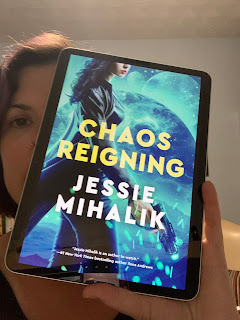
cover of Chaos Reigning with woman holding a firearm and planets on the horizon
Love the cover of Chaos Reigning

Right now, Jessie Mihalik has three AMAZING space operas for you.  I finished the third one, Chaos Reigning, over the weekend. So, yes, I'm basically recommending a series.  You could start with the first one, Polaris Rising, or jump right in the middle with Aurora Blazing. I think all three stand alone pretty well.  There might be a BIT of the space technology better explained in Polaris Rising, but otherwise you'd be missing too much if you don't have a compulsion to start at the beginning and read in order.

All three books are about a von Hasenberg sister.  Chaos Reigning is about the youngest, Cat.  She's young and bubbly, and she knows that means a lot of people underestimate her.  Which is usually fine, because she's spying on behalf of her family to figure out who was behind an earlier kidnapping of her brother, the heir to House von Hasenberg.  One of her sisters knows what Catarina is up to, so she sends Cat with two bodyguards, Aoife (EE-fa) and the smoking hot Alex.  So that one of the guards is always with her, they pretend that Alex is her new, secret lover when the three leave Earth to go to a house party on Honorius.

(Remember, space opera so there are space ships and intergalactic travel.)

While at the house party, Cat and her friend Ying of House Yamado are both attacked, and it takes Aoife, Alex, Ying's bodyguard Cira, and all of Cat's supersecret abilities to get them both safely away.

Once free, Cat realizes that most of the High Houses have been attacked on Earth, and all the residents are being threatened by The Syndicate, a criminal organization run by the Silva family.  Cat, Ying, Alex, Aoife, and the injured Cira formulate a plan to sneak back to Earth and save the day.

Somewhere along the line, the romance between Cat and Alex becomes more than pretense, and they figure out how to trust each other and be together in this action-packed fight against betrayal and the old guard.

Want to know how it all ends?  You'll need to get your own copy to see.  You won't be disappointed.


Pin It

Monday, May 18, 2020

Deal With The Devil by Kit Rocha

A couple of weeks ago, I had the BEST news from NetGalley--approval for an ARC for a book that I was CRAVING.

In 6 B.C-19*, I wrote my first review of a Kit Rocha story.  You can read it here.  It's fair to say I'm a straight-up Kit Rocha Fan Girl.  So you can imagine my response when I found out that I'd been approved for an ARC of the first book of the new Kit Rocha series, Deal With The Devil, in exchange for a review.

It was VERY dignified. *cough* Very.


Deal With The Devil is a Mercenary Librarians novel, and it's set in the same post-apocalyptic timeline that the O'Kane books are set, but the location is different.  So far, there are no character connections, but everyone is dealing with the same "how do we live now that everything is broken" situation.  (There was a nice Easter egg mention of the whisky from Sector Four from their last series, though.)

The Mercenary Librarians are actually quite more benevolent than their name sounds.  They're not hoarding knowledge and texts (remind me to review Rachel Caine's Great Library series soon, would ya?), but they do need to support themselves and help a few neighbors while they're at it.  So when the leader, Nina, gets an offer to go after a rogue Library of Congress bunker, she gathers up her team and heads out with The Silver Devils--a team of elite soldiers formally employed by the local tech giant--despite the possibility that this offer is too good to be true. She wants to save all the knowledge that's been lost and find a way to make is accessible to the people around her.

Garrett, the leader of the Silver Devils, doesn't have quite that altruistic of a goal in mind.  He's actually setting a trap for Nina; he's desperate to trade Nina for another woman who can stop the Silver Devils from dying. Their former tech giant employer has been augmenting its soldiers for years, and once the Silver Devils left the company they were cut off from the upgrades and necessary maintenance to keep their hearts and brains functioning correctly.

So the two teams set off toward the rogue bunker, and have some adventures, and get to know each other better.  And Garrett is in a bind.  He likes Nina, and, oh, man, does he want Nina, but he's about to betray Nina.  So there's interpersonal tension to go along with the post-apocalyptic danger, and there's just a lot of really compelling stuff going on.

Which I liked and will probably love on the re-read.
Why didn't I love it the first time through?

Because I HATE hate hate hate books where the inevitable betrayal is baked into the plot.  While I was all *Kermit arms* about getting the ARC, I also speed read the whole thing like this: 

little girl covering eyes with hands and peeking through

I mean, I trust Kit Rocha to make everything work out in the end, but Garrett was taking TOO LONG to tell Nina what was going on.  And then there was this TWIST that I did not see coming, and, oh, yeah, Garrett was screwed.  It was also pretty unclear how it was going to all work out in the end.

Because, as I said, there was a lot of really compelling stuff going on.

So, if you want to know how it works out for Nina and Garrett, and you're more comfortable with sturm und drang than I am, you should definitely read Deal With The Devil.  Even if you're wimp like I am, you should read it.  It's good, and finishing it just made me greedy for the next one.

*Six year before COVID-19, or 2014.


Pin It

Monday, August 20, 2012

Shadow Show edited by Sam Weller & Mort Castle

I finished reading Shadow Show on the train ride back from Tahoe.  That was at the very beginning of August.  I thought I'd review it right away, but I couldn't.  I went into it with rich expectations, on a high from re-reading The Illustrated Man, but the reality of finishing it was a slog.  It wasn't horrendous, but it was work, and I struggled to rectify how anything written in the spirit of Ray Bradbury could be work.  But it was, so I put it away.

With a heartfelt sigh, I pulled it back out today so that I could write a review.  After all, we didn't start this blog just to act as relentlessly perky cheerleaders (and I have years of cheerleading camp under my belt so I know of which I speak). We started it so we could share recommendations, from the sublime to the simply awful.  With that sense of duty, I picked Shadow Show up again.

And, I realized that if I could sum up the book in one phrase, it would be this:

That's Italian for "so-so".

Shadow Show is anthology of short stories written by authors who credit Ray Bradbury as an inspiration and a mentor.  It's meant to celebrate his life and his works. As with any collection of stories penned by different hands, it's uneven.  Some of a stories are delights that I would recommend you read even without the Bradbury association.  The rest? Well, they elicited responses ranging from indifference to indignity.  I suppose it was that uneven performance that made reading the book feel like such work to me.  As we've pointed out in reviews of The Illustrated Man and Something Wicked This Way Comes, reading Ray Bradbury is easy and beautiful.  Shadow Show has it's moments, but typically misses that mark.

Had the book been printed without a single Bradbury reference, I might have liked it more, I think,  because I would have expected less.  But with the build-up as a tribute to Bradbury's influence, the few stories that did him--in my humble opinion--a disservice overwhelmed my appreciation from the truly good stories.

Now, if you aren't the total Bradbury fangirl that I am, you might react more favorably, but I strongly discourage your from reading anything Bradbury right before you pick this up.

With that said, here are the names of the short stories that really worked--on their own and as Bradbury tributes:

"The Man Who Forgot Ray Bradbury" by Neil Gaiman
"Headlife" by Margaret Atwood
"Heavy" by Jay Bonansinga
"By The Silver Water of Lake Champlain" by Joe Hill
"Children of the Bedtime Machine" by Robert McCannon
"Conjure" by Alice Hoffman
"Backward in Seville" by Audrey Niffenegger
"Hayleigh's Dad" by Julia Keller

For those of you wondering, there are 27 tales all told, so this list comprises one-third of the total count. So, again, not horrendous, but overwhelmingly not Ray.


Pin It

Tuesday, July 10, 2012

Old Man's War by John Scalzi

I'm late to the John Scalzi party.


My social media addiction regularly introduces me to authors whose works I haven't read.  Most of the time, I respond with an internal thought of  "I should get around to reading her/his stuff."   Every once in a while the social media universe (for me, that's mostly the blogosphere and the Twitterverse and the FB galaxy) provides multiple reference to a new work or for a single author.  Eventually, those repeated points of contact hit critical mass, and I accept the advice the social media world is sharing.

This time, it was "READ JOHN SCALZI."

And so I did.

And then I was annoyed that the social media pundits had waited so long to send me a sign.

People, I'm way late to the party, and it's a hell of a shindig.

According to his own website, John Scalzi is best known for a series of books that started with Old Man's War.  I devoured the first one last week in Italy, and I plan to start (and finish) the second one, The Ghost Brigades, tomorrow.  (I'm not alone in this admiration.  Old Man's War was nominated for major awards and polls as a reader favorite for sci-fi fans.  I TOLD you it was a hell of shindig.)
What if all that was old
could be new again?

Old Man's War is a tale of John Perry, a widower who joins the military ranks on his seventy-fifth birthday.  (Yes, you read that right. Thus, the name of the book.)  This particular army is interested in recruits willing to cut their ties to Earth for a chance to live in a galactic colony after serving at least two, but as many as ten, years.  Most people sign up because they assume that the army has a way of fixing all the physical indignities of the natural aging process.  Why else would they let senior citizens sign up?While the chances of serving and surviving aren't high, the chances that most 75-year-olds will make it to 85 without medical intervention are just as slim.  And so John goes.  He IS fixed up, and he fights, and he learns about an entire universe of technology and biology he never knew before.  


Old Man's War is a story of major "what ifs". What if you could be physically "cured" when you hit 75?  What would you give up in order for that to happen?  What if there were intelligent lifeforms smarter, faster, meaner, and more zealous than anything Earth has to offer?

I thought this was an amazing book because it took some crazily complicated technological possibilities and made an easy read out of them.  I, like a few of the characters in the book, don't have the math to understand the physics of John's new world.  That didn't stop me from reading, (mostly) understanding, and enjoying what was going on.  So please don't let a lack of science (or math) stop you from reading this.  It's THAT good.

Come on.  Join me in making a tragically late appearance to the John Scalzi party.


Pin It

Tuesday, June 19, 2012

The Illustrated Man by Ray Bradbury

On June 6, I found out that Ray Bradbury had shuffled off this mortal coil.  It hit me hard that first day, and, by the end of the week, I cried.

(Here's a link to the article that made me cry.  I cried just now, reading it again.)

In some ways, that's such an odd reaction.  I didn't personally know Mr. Bradbury, I hadn't read one of his stories in years, and he had lived a full life by all accounts.  But he had given me so very much, and it hurt that he was gone.

Go in peace, Mr. Bradbury.
A million thanks for all the stories.
Ray Bradbury wrote the first science fiction that I ever intentionally read.  In truth, he's a wonderful entry into that type of book because his stories are more about the people than the science.  You don't need a B.S. in astrophysics for The Martian Chronicles to please you or to pique you. You simply need some curiosity and an open mind.  So he introduced me to the genre and because of his craftsmanship he kept me there.  He told amazing stories about how Martians react to Earth-made rocket ships, about how censorship can't stop people from learning, about how carnivals aren't always as they seem, and about how technology is no replacement for parenting.

Ahh.  That last one.  That's "The Veldt" from The Illustrated Man.  Good grief, that one gives me the heebie-jeebies.  (Just like "The Earth Men" from The Martian Chronicles.  Just like Fahrenheit 451. Just like Something Wicked This Way Comes.  Seriously, he could tell an amazing tale.)  In "The Veldt", George and Lydia Hadley have purchased the very best of homes, a Happy Life Home.  In Mr. Bradbury's words, this Happy Life Home "clothed and fed and rocked them to sleep and played and sang and was good to them".  This sounds like a very nice home, indeed, but the Hadleys discover that ceding some of their parental responsibilities to a house leads to a very not-nice outcome.  The house, you see, is programmed to give everyone what they want.  Parents, on the other hand, will occasionally tell their children "no".  Children with access to a powerful machine compelled to keep them happy have, by proxy, a lot more power than conscience.  In Mr. Bradbury's hands, this leads to chilling consequences.
What would I do if my tattoo moved?

"The Veldt" is the first of book of short stories from The Illustrated Man.  The stories are linked together through the basic premise of the Illustrated Man.  Seemingly like the tattooed men of carnivals, the Illustrated Man has ink that moves and predicts the future.  As a young boy watches the illustrations change, the short stories of The Illustrated Man unfold.  The stories are quick hits of discovery and fear and sadness and madness that surely will intrigue you.  For the Bradbury fans out there, I encourage you to re-read this one.  If you don't normally read science fiction or fantasy, this is still a great book to read.  Mr. Bradbury could be your entrance to a whole new world of books.  (Pun fully intended.) Pin It

Thursday, May 10, 2012

The Color of Magic by Terry Pratchett

 I'm not a big science fiction or fantasy reader.  I like supernatural stuff just fine; ghosts, vampires, werewolves, what-have-you, but I've never been very good at imagining whole other galaxies and physical worlds.  That's why I was so surprised when I loved everything about The Hitch-Hiker's Guide series.  Admittedly, I had to re-read the first one to feel truly comfortable with who/what the characters were and what the real issues happened to be, but from there on I was hooked.  So with that in mind, I decided to venture outside my usual fiction/literature picks and grabbed a copy of The Color of Magic by Terry Pratchett.  I already plan on re-reading it to get myself more comfortable with the set-up, but I'm glad I took the risk on this one.

This is actually the first of a large, seemingly rambling, series and it's over 25 years old.  It could buy us all a drink at the bar.  But it's not dated, probably thanks to the alternate setting: Discworld.  Discworld is, well, a disc that happens to be resting on the backs of four giant elephants who are standing on the back of an even giant-er turtle.  On this disc there are lands, seas, desserts (and deserts), heroes, gods, wizards, dragons (sort of), mercenaries, trolls, tree-dwellers, smart but mean luggage, and one very frustrated and busy Death.  And that's just what I can name off the top of my head.  The Color of Magic follows Rincewind the Wizard and Twoflower the Tourist through their rambling voyage around and off Discworld.  Rincewind is mostly a wizard in name only due to an unfortunate event at school, and has since been more of a grifter than anything.  Twoflower comes to visit the great and seedy twin cities of Ankh-Morpork.  He is tired of his safe and predictable life as an insurance man.  So he travels to Ankh-Morpork to witness brawls, see heroes, meet wizards, and really live, ya know? 

Twoflower has a bit too much trust in others and naively ventures forth with little knowledge of the local language or currency.  His rich beyond measure in his new environment and he is surrounded by an entire city's worth of underbelly who are all too willing to help rid him of his wealth.  Fortunately for Twoflower there are other events set into motion by ever-watchful gods, and Rincewind becomes his reluctant translator and tour guide.  Throughout the book they manage to burn an entire city, save a hero, ride dragons, and fall off the edge of the disc.  All the while, Twoflower's luggage follows doggedly behind swiftly dispatching anyone to which it takes a disliking, and Rincewind is able to cheat Death on more than one occasion.  Nothing about this book takes itself too seriously:  one of the several reasons I enjoyed it so.  The pace of the story is swift though I wouldn't call it a logical procession.  There's a lot to keep track of which had me going back to the beginning a couple of times. {This is why I have to re-read science fiction.  My short-term memory has a very low capacity.  I blame my children.}  However, I'm looking forward to reading more of this series.  Especially now that I know the color magic is octarine; a sort of fluorescent greenish yellow purple.  So if you're wanting something outside of your spherical-world norm, I'd recommend something flatter like Discworld.   


Pin It

Monday, June 6, 2011

And Another Thing by Eoin Colfer

To carry on the trend of writing a review while actually recommending a series, I present to you And Another Thing.  If you haven't read The Hitchhiker's Guide to the Galaxy and its accompanying works (The Restaurant at the End of the Universe, Life, The Universe and Everything, So Long and Thanks for all the Fish, and Mostly Harmless), I highly recommend you do.  For one thing, you'll learn just how truly valuable a towel can be in times of crisis and they're quite funny.  Douglas Adams wrote the trilogy (which later turned into five books and when asked about the incorrect number of books for a trilogy he replied it was due to a miscommunication with his publisher and his shoddy grasp of arithmetic) that mostly takes place in outer space and other worlds, based on the series he wrote for BBC Radio.  They are not new, as a matter of fact the first book is almost as old as I am, but to me they are timeless.  So start with them if you haven't already.

Once you're done with those, read And Another Thing by Eoin Colfer.  Wait! That's a different author, you say?  Well sadly, Mr. Adams passed away unexpectedly (heart attack at the age of 49) and left notes for another H2G2 novel on his computer.  I'm not entirely clear on how they picked Eoin Colfer to put those notes and his own spin on things to make And Another Thing, but I'm happy they did.  Eoin Colfer writes the Artemis Fowl series (which is probably considered a children's book rather than young adult, but I'm murky on that area of classification) and both Carrie and I rather like that series as well.  *So really I'm recommending two series with one review which I'm sure is a record and probably why it's taking me forever to actually talk about the book I'm supposed to be reviewing.  But you should really read them even if you don't like science fiction or magic books because they are smart and funny and well-written and made me wish they wouldn't end and they're both even funnier if you imagine that John Cleese is the narrator because everything is funnier when John Cleese says it.  And, breathe.*  While Mr. Colfer is not the original creator of cast of characters in this book, I felt like he understood them well enough to carry it off.

Pretty much everyone's back in this one:  Arthur, Zaphod, Random, Trillian, and Ford are the focus but we get cameos from other old friends as well.  The plot is entirely out-of-the-box, but the whole series pretty much embraces and embodies that way of thinking.  Space-time continuum issues, failing batteries, imminent destruction, holographic mistakes, ego-maniacal deities, and perfectly ordinary people screwing up perfectly good planets pack this book with content.  Perhaps maybe a little too much, but you'll probably be having too much fun hearing John Cleese in your head to notice.  And to put anyone who doesn't think they'd like a series set in space and its various quadrants at ease, I am not a huge fan of Star Trek or Star Wars.  I appreciate them but I have never felt the urge to don any kind of costume, do any kind of salute, or learn any kind of created language after seeing either of them.  This is different.  In Mr. Colfer's words: "Imagine if Messrs. Hawking and Fry were locked in a room with the entire cast of Monty Python and forced to write a book which would subsequently be edited by Pink Floyd, then the result would need a lot of work before it could be cut from Douglas Adams’ first draft."  I, for one, sincerely hope they ask Mr. Colfer to write another.  Whether they lock all those people in a room or not.

Links!
Douglas Adams
Eion Colfer
H2G2 books on Amazon
Artemis Fowl books on Amazon Pin It